
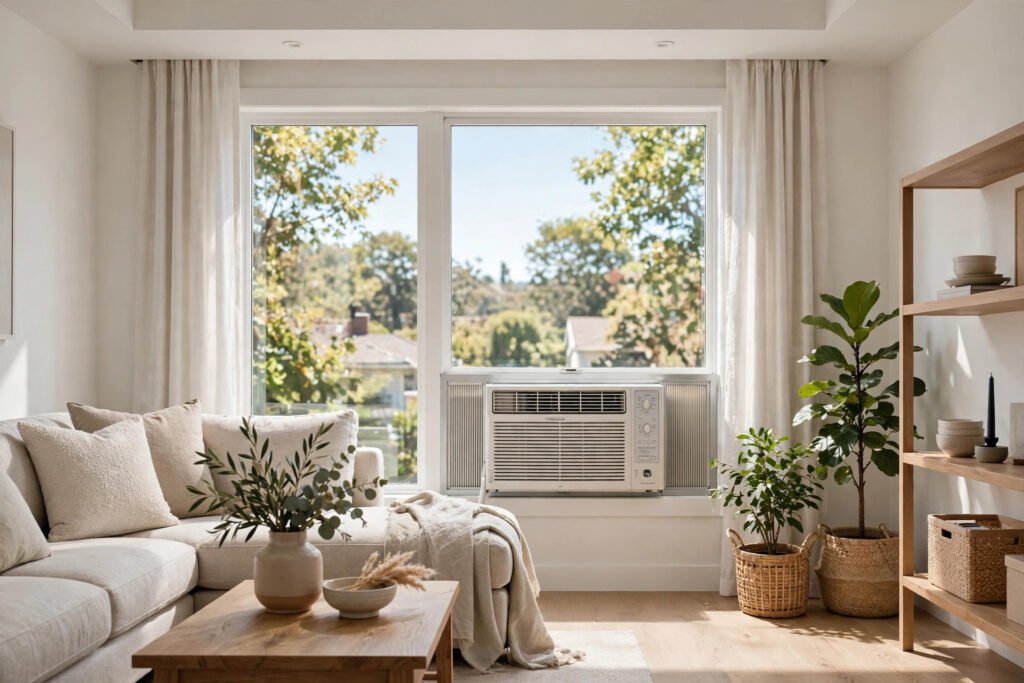
The most expensive air conditioner mistake isn't buying a bad brand — it's buying the wrong size. Too small and it runs nonstop on hot days without ever catching up. Too big and it short-cycles: blasting cold air for five minutes, shutting off, and leaving you with a cold, clammy, humid room. I learned this the hard way when I put a 12,000 BTU window unit in my 450 sq ft living room. It froze the room in twenty minutes, shut off, and the humidity made everything feel sticky.
Sizing an AC comes down to one number: BTU (British Thermal Unit). For air conditioners, BTU measures cooling power — roughly, how much heat the unit can remove per hour. Bigger room = more BTUs needed. But square footage is only the starting point.
The BTU Chart: Start Here
This is the baseline chart every manufacturer publishes. Find your room's square footage and read across:
| Room size (sq ft) | Base BTU needed |
|---|---|
| 100–150 | 5,000 |
| 150–250 | 6,000 |
| 250–300 | 7,000 |
| 300–350 | 8,000 |
| 350–400 | 9,000 |
| 400–450 | 10,000 |
| 450–550 | 12,000 |
| 550–700 | 14,000 |
| 700–1,000 | 18,000 |
| 1,000–1,200 | 21,000 |
| 1,200–1,400 | 23,000 |
| 1,400–1,500 | 24,000 |
These numbers assume standard 8-foot ceilings, decent insulation, and average sun exposure. Almost no real room matches all three, so the next step is adjusting.
The Adjustments That Actually Matter
The chart gets you in the ballpark. These adjustments get you to the right answer. Run through them in order:
Sunny room: +10%
If the room gets direct afternoon sun through big windows — especially west-facing — add 10% to the chart BTU. Sunlight is a massive heat load. My home office faces west with a 4×5 foot window, and the afternoon sun adds the equivalent of a space heater running in the corner.
Shaded room: −10%
If the room is heavily shaded by trees, an overhang, or it faces north with small windows, subtract 10%. My north-facing guest bedroom barely warms up in July, and the chart size short-cycles there.
Kitchen: +4,000 BTU
A kitchen has a stove, an oven, a refrigerator, and usually more people in it. Add a flat 4,000 BTU on top of whatever the chart says. This is the adjustment people skip most often, and it's why kitchen window units always seem to struggle.
More than 2 people regularly: +600 BTU per person
Each person gives off roughly 600 BTU per hour of body heat. A home office with two people, a TV room where four people watch movies — add 600 BTU per extra person beyond the first two.
High ceilings: adjust proportionally
The chart assumes 8-foot ceilings. If you have 10-foot ceilings, multiply the BTU by 1.25 (10 ÷ 8). For a 12-foot ceiling in a great room, multiply by 1.5. You're cooling volume, not floor area.
Worked Example: My 350 Sq Ft Sunny Bedroom
Let me run the full calculation the way I did it for my own master bedroom last summer. It's 350 square feet, faces southwest, gets blasted by afternoon sun, has 8-foot ceilings, and it's just my wife and me.
Step 1: Chart BTU. 350 sq ft falls in the 300–350 range → 8,000 BTU base.
Step 2: Sunny room adjustment. Big southwest windows, direct sun from 2pm to 7pm → +10%. 8,000 × 1.10 = 8,800 BTU.
Step 3: Occupancy. Two people — no adjustment needed (only add for more than two).
Step 4: Ceilings. Standard 8-foot → no adjustment.
Final answer: 8,800 BTU → buy a 9,000 BTU unit (round to the nearest available size; don't round down).
I almost bought a 10,000 BTU unit "to be safe." That extra 1,200 BTU would have pushed it into short-cycling territory on mild days. The 9,000 BTU unit holds the room at 72°F and, just as important, keeps humidity in check because it runs long enough to wring moisture out of the air.
Why Oversizing Is Worse Than Undersizing
This surprises people. An oversized AC cools the air fast and shuts off — but cooling is only half the job. The other half is dehumidification, and that only happens while the unit is running. A 14,000 BTU unit in a room that needs 9,000 will drop the temperature in ten minutes and shut off, having removed almost no moisture. Result: 70°F and damp. It feels like a basement.
An undersized unit has the opposite problem: it runs constantly on the hottest days and may never reach your set temperature. But a slightly undersized unit at least dehumidifies well and feels comfortable at 74°F.
The sweet spot: within about 10% of your calculated number, erring slightly low rather than high. If your math says 8,800 BTU, a 9,000 unit is perfect; an 8,000 is fine; a 12,000 is a mistake.
Window Unit vs Portable vs Mini-Split: BTU Isn't Everything
BTU tells you cooling power, but the type of unit affects how much of that power actually reaches you:
| Type | Efficiency | Noise | Best for |
|---|---|---|---|
| Window unit | Best BTU per dollar | Moderate (half the noise is outside) | Single rooms, budget installs |
| Portable (single hose) | Worst — wastes 20–30% of its BTU pulling in hot air | Loudest | Renters who can't install a window unit |
| Portable (dual hose) | Decent | Loud | Renters, better than single-hose |
| Mini-split | Best overall efficiency | Quietest (compressor is outside) | Permanent installs, multiple rooms |
A 10,000 BTU single-hose portable delivers roughly the cooling of a 7,000–8,000 BTU window unit because it exhausts room air outside, pulling hot makeup air in through every crack. If you're choosing a portable, go one chart size up to compensate — or better yet, get a dual-hose model.
Installation Factors That Change the Math
Insulation and air sealing matter more than brand. I once helped a friend who was convinced his 12,000 BTU unit was defective in a 400 sq ft room. The real problem: a 1-inch gap under the door and single-pane 1960s windows. We spent $40 on weatherstripping and window film, and the "defective" AC suddenly worked fine.
Check the circuit. A 12,000+ BTU window unit can pull 10–12 amps. If it's sharing a 15-amp circuit with a TV and a lamp, you'll trip the breaker on startup. Big units (18,000+ BTU) often need a dedicated 20-amp circuit — check the plug type before you buy.
Measure the window. Window units need a double-hung window of a specific width range. Measure twice. I watched a neighbor try to return a unit in July because his windows were 4 inches too narrow. In July, everything is sold out.
Look at CEER, not just BTU. CEER (Combined Energy Efficiency Ratio) tells you how efficiently the unit converts electricity to cooling. A 10,000 BTU unit with a CEER of 12 costs roughly 20% less to run than one with a CEER of 10. Over a summer of heavy use, that's $30–60 back in your pocket.
Common Mistakes
1. Buying "one size up to be safe." The most common sizing error in America. Oversized units short-cycle, leave humidity high, and wear out faster from constant starting and stopping.
2. Forgetting the kitchen adjustment. Kitchens need +4,000 BTU. A chart-sized unit in a kitchen will run all day and lose ground every time you cook dinner.
3. Ignoring ceiling height. A 400 sq ft room with 12-foot ceilings has 50% more air to cool than the chart assumes. Multiply accordingly.
4. Choosing a single-hose portable for a big room. The negative pressure problem is real. In a leaky older house it can waste a third of its rated BTU.
5. Blocking airflow. An AC needs 20+ inches of clear space around it (more for the outdoor side of a window unit). Pushing it into a corner behind curtains strangles its output.
6. Sizing for the hottest day of the decade. Size for a typical hot day, not the record heatwave. An AC that's perfect 95% of the summer and struggles on two extreme days is correctly sized.
7. Not checking the electrical. Tripping breakers all summer because the unit shares a circuit is a miserable, avoidable problem. Read the amp draw on the spec sheet.
FAQ
What size AC do I need for a 400 sq ft room? The chart says 10,000 BTU for 400–450 sq ft. Adjust from there: add 10% (→ 11,000) if it's sunny, subtract 10% (→ 9,000) if heavily shaded, add 4,000 BTU (→ 14,000) if it's a kitchen. Most standard bedrooms and living rooms land right on 10,000.
Is it better to oversize or undersize an air conditioner? Slightly undersize. An oversized unit short-cycles — it cools fast but shuts off before removing humidity, leaving the room cold and clammy. An undersized unit runs longer, dehumidifies properly, and feels more comfortable even a degree or two warmer.
How many BTU per square foot do I need? Roughly 20 BTU per square foot is the baseline (a 300 sq ft room → 6,000–7,000 BTU), but the chart above is more accurate because the relationship isn't perfectly linear. Always apply the sun, shade, kitchen, and ceiling adjustments on top.
What size AC for a 12×12 bedroom? A 12×12 room is 144 sq ft → 5,000 BTU from the chart. If it gets strong afternoon sun, go 6,000. If it's shaded and just for sleeping, 5,000 is plenty. Bedrooms are the easiest rooms to size because the load is simple.
Can a portable AC cool a whole apartment? Not well. A single portable unit is a one-room solution — its effective BTU is 20–30% lower than rated (single-hose models), and cool air doesn't travel far through doorways. For multiple rooms, you need multiple units or a mini-split with multiple heads.
About the Author
Dave Collins is a hands-on DIY enthusiast who has spent the past 15 years renovating three of his own homes. He learned most of what he knows by making mistakes first, then asking pros what he did wrong. On this site he writes practical, numbers-first guides so you can skip the mistakes and get it right the first time.