
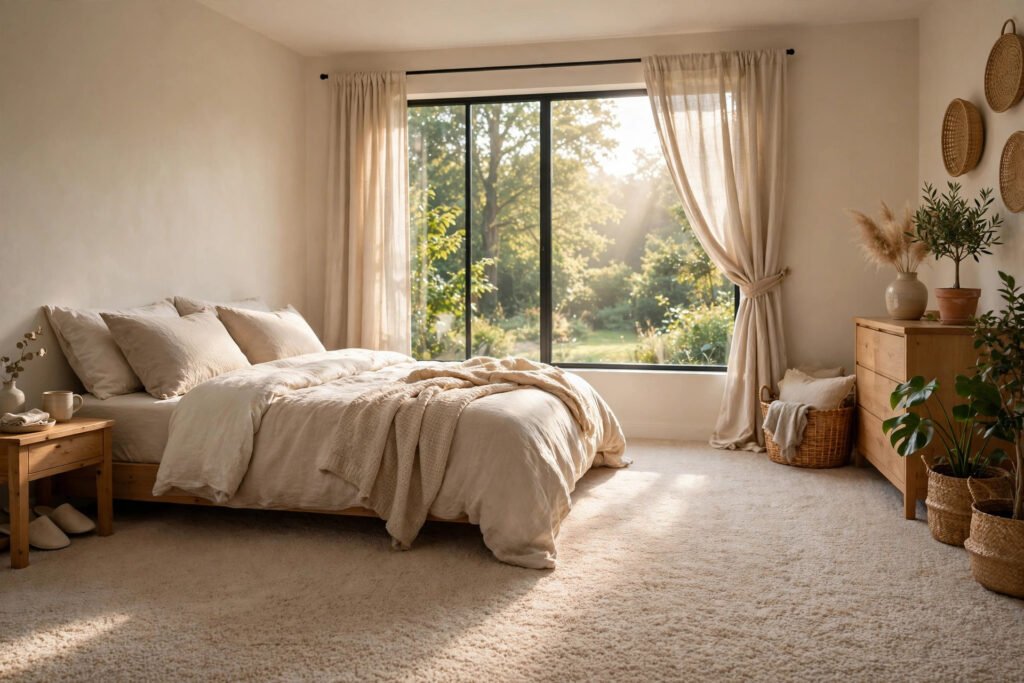
I put laminate in my second bedroom renovation because it looked modern and wiped clean. Six months later, I ripped half of it out and put carpet back in. That cost me about $900 I didn't need to spend, and it taught me something important: bedroom flooring is not like the rest of the house. What works great in a living room can make a bedroom feel cold, echo-y, and just plain wrong.
So here's my honest, no-sponsorship take on carpet versus laminate for bedrooms — what each one actually costs, how they feel at 6 a.m. on a bare foot, how they hold up over time, and which one I'd pick for different situations.
The Short Version
If you want a warm, quiet bedroom and you don't have severe allergies, carpet wins. If you have pets, care about resale simplicity, or want the easiest floor to keep clean, laminate wins. Everything below is the math and lived experience behind that summary.
Cost Comparison: What I Actually Paid
Here's a real side-by-side for a standard 12×14 foot bedroom (168 square feet), which is about the size of a typical primary bedroom in an average American home.
| Cost Item | Carpet | Laminate |
|---|---|---|
| Materials (mid-range) | $560–$840 ($3.30–$5.00/sq ft) | $420–$700 ($2.50–$4.15/sq ft) |
| Underlayment/padding | $100–$170 (pad included in most quotes) | $85–$135 (underlayment required) |
| Installation (pro) | $500–$670 ($3.00–$4.00/sq ft) | $340–$590 ($2.00–$3.50/sq ft) |
| DIY total (materials only) | $660–$1,010 | $505–$835 |
| Pro-installed total | $1,160–$1,680 | $845–$1,425 |
I installed carpet in my guest bedroom myself for about $780 all-in (12×13 room, mid-grade carpet at $3.80/sq ft, decent 8-pound pad). The laminate in my master bedroom ran about $610 in materials for a slightly bigger room — click-lock planks at $2.90/sq ft plus underlayment. Laminate is genuinely cheaper to buy and easier to install yourself. A beginner can lay laminate in a weekend with a saw, a tapping block, and patience. Carpet installation as a DIY project is much harder — seaming, stretching, and kickers take practice, and I would not attempt a carpet install on my first flooring project.
Winner on price: laminate, especially if you're doing it yourself.
Comfort: The 6 A.M. Barefoot Test
This is the one category where carpet destroys laminate, and it's the reason I re-carpeted that bedroom.
Laminate over standard foam underlayment feels hard and cool underfoot. In winter, when my bedroom was 64°F overnight, the laminate felt genuinely cold — not tile-cold, but cold enough that I started wearing slippers to bed, which I hated. Carpet with a quality pad stays at near room temperature and feels soft. Getting out of bed onto carpet versus laminate is just a different experience, and it's the experience you repeat 365 times a year.
That said, carpet comfort depends heavily on the pad. I made the mistake in one bedroom of buying the thinnest pad the carpet store stocked (a 6-pound rebond, about $0.35/sq ft) to save money. Within two years the carpet felt flat and tired. In the next bedroom I spent the extra $0.25/sq ft on an 8-pound, 7/16-inch pad, and it still feels plush four years later. If you choose carpet, the pad is not where you save money.
Winner on comfort: carpet, by a wide margin.
Noise: This Matters More Than You Think
Bedrooms share walls and floors with the rest of the house. Laminate is a noise problem in two directions: it amplifies sound within the room (that hollow click-clack when you walk), and it transmits footfall noise to the room below if the bedroom is upstairs.
My master bedroom is on the second floor. With laminate, my wife could hear every step I took when she was in the kitchen below — a dull thud-thud-thud. We ended up buying a large area rug ($220 for an 8×10) just to dampen it, which ate into the savings of choosing laminate in the first place. If you add a quality rug to laminate, you've bought yourself most of the cost of carpet without the full benefit.
Carpet with a good pad is the best sound dampener you can get in a bedroom. It absorbs footsteps, muffles dropped phones, and deadens the echo that makes hard-floored bedrooms feel cavernous.
Winner on noise: carpet, especially for upstairs bedrooms.
Durability and Lifespan
Here's where laminate fights back. A decent AC3 or AC4 rated laminate will hold up in a bedroom for 15–25 years. Bedrooms are low-traffic compared to hallways and kitchens, so laminate barely wears. It doesn't stain, it doesn't trap odors, and it doesn't develop the worn "traffic lanes" that carpet shows where you walk between the bed and the door.
Carpet in a bedroom typically lasts 8–12 years before it looks tired, even in a low-traffic room. The fibers crush where you step getting out of bed, and dust settles deep into the pile where vacuums struggle. I replaced my guest bedroom carpet after 9 years not because it was destroyed, but because it just looked dingy no matter how well I cleaned it.
One important nuance: carpet hides dirt and laminate shows it. That cuts both ways. Laminate shows every dust bunny, which means you'll sweep more often. Carpet looks fine while quietly accumulating dust — which is a real consideration if anyone in the house has allergies.
Winner on durability: laminate.
Cleaning and Maintenance
Laminate: sweep or dry mop weekly, damp mop monthly. Done. A spilled cup of coffee wipes up in seconds. I've never had a laminate stain I couldn't remove with a damp cloth.
Carpet: vacuum at least weekly, deep clean (rented machine or pro service) once or twice a year. A spilled cup of coffee on carpet is a project — blot immediately, treat with cleaner, and hope it doesn't wick back up as it dries. In a bedroom this matters less than in a kitchen, but if you drink coffee or tea in bed, it will eventually happen.
My honest math: carpet costs me about 2–3 hours a year of extra maintenance per bedroom versus laminate, plus roughly $50–$75 a year if I rent a carpet cleaner annually.
Winner on cleaning: laminate.
Allergies and Air Quality
I have to be straight here because this is where carpet takes its hardest hit. Carpet traps dust mites, pet dander, and pollen. If someone sleeping in that bedroom has asthma or serious dust allergies, carpet is genuinely the wrong choice — no amount of vacuuming matches a hard surface you can damp-mop clean.
That said, there's a middle ground people miss. A 2019-era shift in carpet manufacturing brought genuinely low-VOC carpets and hypoallergenic pads to the mid-price market. When I re-carpeted, I specifically bought a low-VOC carpet (the label said CRI Green Label Plus) and aired the room out for 48 hours before sleeping in it. The new-carpet smell — which is mostly the latex backing off-gassing — was gone in two days. If you go carpet, look for that Green Label Plus certification and don't skip the airing-out step. I slept in a guest room the first night after one install and I'm glad I did; the smell was strong for the first 12 hours.
Winner on allergies: laminate, no contest for sensitive sleepers.
Resale Value
Real estate agents consistently tell me the same thing: laminate (or hardwood-look flooring generally) photographs better and appeals to more buyers. Carpet is polarizing — buyers either don't care or immediately budget to replace it because they assume it's dirty. When I sold my first house, the listing photos of the laminate bedrooms looked crisp and clean. The carpeted bedroom looked fine in person but slightly dated in photos.
If you're renovating to sell within a couple of years, laminate is the safer bet. If you're staying, pick what you'll enjoy living on.
Winner on resale: laminate.
Decision Table: Which Should You Choose?
| Your Situation | My Recommendation |
|---|---|
| You sleep cold / hate slippers | Carpet with 8-lb pad |
| Upstairs bedroom over living space | Carpet (noise control) |
| Pets sleep in the bedroom | Laminate (hair and accidents clean easier) |
| Allergies or asthma in the household | Laminate |
| Renovating to sell within 2 years | Laminate |
| You want the cheapest DIY weekend project | Laminate |
| You want maximum comfort and coziness | Carpet |
| Rental property bedroom | Laminate (durability between tenants) |
Common Mistakes
1. Buying the cheapest pad to "save money." I did this. The carpet felt flat within two years and I essentially paid for a re-pad job. Spend the extra $0.20–$0.30 per square foot on an 8-pound pad. It's the best money in the whole project.
2. Installing laminate without checking subfloor flatness. My first laminate job went over a subfloor with a 1/4-inch dip I didn't notice. Within a year the click-lock joints over that dip started separating. Laminate needs the subfloor flat to within 3/16 inch over 10 feet. Check it with a long straightedge before you start, and use self-leveling compound where needed.
3. Forgetting expansion gaps with laminate. Laminate expands and contracts with temperature and humidity. I buckled a closet section by running the planks tight to the wall. Leave a 1/4 to 3/8 inch gap around all edges, hidden by baseboards.
4. Choosing carpet color from a 2-inch sample. Carpet looks darker once it's installed across a whole room, and showroom lighting lies. I once picked what looked like a warm beige and ended up with something closer to tan. Always take the largest sample they'll give you, lay it on your floor, and look at it in morning and evening light.
5. Skipping the moisture check on concrete slabs. If your bedroom is on a slab (common in single-story homes and basements), tape a 2×2 foot piece of plastic sheeting to the concrete for 48 hours. If moisture collects under it, you need a moisture barrier before either flooring type — but it's a deal-breaker for laminate if you ignore it, since trapped moisture warps the planks.
FAQ
1. Is carpet or laminate better for a kid's bedroom? Laminate, in my experience. Kids spill things, drag in dirt, and carpet in a kid's room shows every bit of it. Laminate wipes clean, and you can always add a washable area rug for warmth. I put laminate in both my kids' rooms and rugs on top — best of both worlds, and the rugs go in the washing machine.
2. How long does bedroom carpet actually last? 8 to 12 years for a mid-grade carpet in a bedroom, in my experience across three houses. The pad matters more than people think — a good pad can add 2–3 years of decent feel. High-traffic lanes (bed to door, bed to closet) show wear first.
3. Can I install laminate directly over old carpet? No. Pull the carpet and pad out first. Laminate needs a firm, flat surface, and carpet underneath creates a spongy base that will flex the click-lock joints until they fail. I learned this the expensive way in a hallway — the joints started clicking and separating within six months.
4. Does laminate increase home value more than carpet? Generally yes, modestly. Appraisers and agents treat hard-surface flooring as an upgrade over carpet. You're not going to recoup the full cost of a flooring job at sale, but laminate photographs better and turns off fewer buyers. I'd estimate it helps more than it costs, especially in a primary bedroom.
5. What's the cheapest way to make laminate feel warmer in a bedroom? A large area rug with a thick rug pad underneath. An 8×10 rug covers most of the walking area in a standard bedroom, and a 1/2-inch felt rug pad underneath adds real cushion and insulation. Budget $200–$350 total. It's what I did in my laminate bedroom before I eventually re-carpeted, and it solved about 70% of the comfort problem.
About the Author
Dave Collins is a hands-on DIY enthusiast who has spent the past 15 years renovating three of his own homes. He learned most of what he knows by making mistakes first, then asking pros what he did wrong. On this site he writes practical, numbers-first guides so you can skip the mistakes and get it right the first time.