
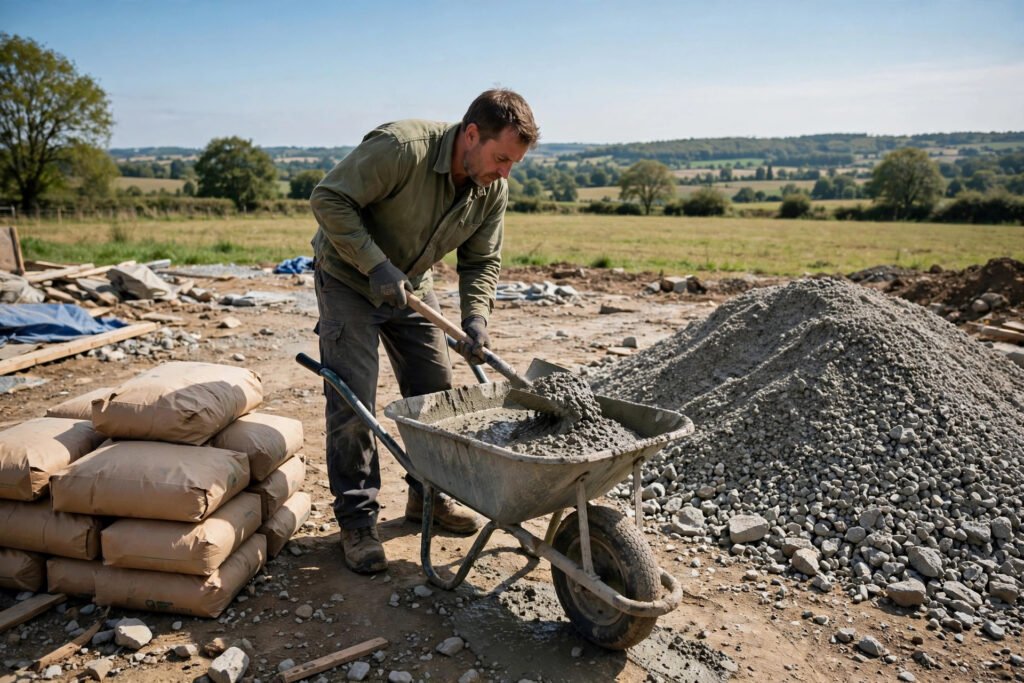
The first time a contractor told me to mix concrete "one-two-three," I nodded like I understood and then went home and googled it. If you're in that spot now, here's the short version: a concrete mixing ratio like 1:2:3 means 1 part cement, 2 parts sand, and 3 parts gravel, measured by volume. That's it. Everything else in this article is about which ratio to pick, how to measure "parts" without a scale, and how much water to add so your concrete is strong instead of crumbly.
I mix my own concrete for small jobs — footings for a deck, setting fence posts, a little pad under my shed. For anything bigger than a wheelbarrow or two, I buy bagged mix or order a truck. Knowing the ratios helps in all three cases, because even a bag of pre-mix is just someone else's ratio decision.
What the Numbers Actually Mean
A concrete mixing ratio is always written cement : sand : aggregate (gravel or crushed stone). All parts are measured by volume, not weight. So 1:2:3 means:
- 1 bucket of Portland cement
- 2 buckets of sand
- 3 buckets of gravel
A "part" can be anything — a bucket, a shovel, a coffee can — as long as you use the same container for all three ingredients. Consistency is the whole game.
Why does the order matter? Cement is the glue. Sand fills the gaps between the gravel. Gravel gives the concrete its bulk and compressive strength. Change the ratio and you change the character of the finished concrete: more cement means stronger but more expensive and more prone to cracking from shrinkage; more aggregate means cheaper but weaker.
The Common Ratios and What They're For
You don't need to memorize a dozen ratios. In residential DIY work, you'll use one of these four:
| Ratio (cement:sand:gravel) | Typical strength | Best for |
|---|---|---|
| 1:2:4 | ~2,500–3,000 psi | Fence posts, non-structural fill, bedding |
| 1:2:3 | ~3,000–3,500 psi | General purpose: footings, small slabs, sidewalks |
| 1:1.5:3 | ~3,500–4,000 psi | Driveways, structural footings, garage slabs |
| 1:1:2 | ~4,500+ psi | High-strength work: steps, thin sections, precast |
For 90% of what a homeowner mixes by hand, 1:2:3 is the answer. It's the general-purpose ratio — strong enough for footings and small slabs, forgiving to mix, and not wasteful on cement. When I poured footings for my deck, I used 1:2:3. When I set my mailbox post, 1:2:4 would have been fine, but honestly I just used 1:2:3 for both because I had one recipe in my head.
The one place I'd step up to 1:1.5:3 is a driveway or anything a car drives on. The extra cement is cheap insurance.
How to Measure "Parts" Without a Scale
Nobody weighs sand in a backyard. Use a 5-gallon bucket as your "part" — it holds about 0.67 cubic feet. A standard round-point shovel heaped holds roughly 0.35 cubic feet, so two heaped shovels are close to one bucket, but shovels are inconsistent. For small jobs, shovels are fine. For anything structural, use the bucket.
Here's the worked example from my shed pad. I needed about 1.5 cubic feet of concrete to fill two small pier footings, and I was mixing with a 5-gallon bucket as my part:
- Dry ingredients for a 1:2:3 mix: 1 bucket cement + 2 buckets sand + 3 buckets gravel = 6 buckets of dry material.
- Yield math: Dry ingredients shrink when mixed with water — a rule of thumb is that dry volume × 0.55 to 0.60 gives you wet, placed concrete. So 6 buckets (about 4 cubic feet dry) yields roughly 2.2 cubic feet of finished concrete.
- Scaling to my need: I needed 1.5 cubic feet, so I mixed a half batch: half a bucket of cement, 1 bucket of sand, 1.5 buckets of gravel. That gave me about 1.1 cubic feet per batch, and I mixed two batches.
Notice I didn't stress about exact halves of a bucket. Eyeballing "about half" is fine for footings. If I were pouring a structural beam, I'd measure carefully and probably just order ready-mix instead.
Water: The Part Everyone Gets Wrong
Here's the thing that took me longest to learn: water weakens concrete. Every extra gallon you add to make mixing easier costs you strength. The pros talk about the water-cement ratio — the weight of water divided by the weight of cement — and for residential work you want it around 0.45 to 0.55. In plain terms: the mix should look like thick oatmeal, not soup.
Practical guidance:
- Start with about 60% of the water you think you need, mix, then add slowly.
- For one 80-lb bag of Portland cement in a 1:2:3 mix, that's roughly 4–5 gallons of water total. Add 3 gallons first, then adjust.
- The slump test: scoop some mix into a pile. It should hold its shape with a slight slump. If it flows like pancake batter, you've added too much water and there's no fixing it — you can't take water out.
The first footing I ever mixed, I kept adding water because it was hard to stir. The concrete cured chalky and crumbly, and I had to dig it out and redo it. Hard to mix is normal. Soup is failure.
Step-by-Step: Mixing a Batch in a Wheelbarrow
- Measure your dry parts. For 1:2:3 with a bucket: 1 bucket cement, 2 buckets sand, 3 buckets gravel into the wheelbarrow.
- Dry-mix first. Shovel it over on itself three or four times until the color is uniform gray with no streaks of brown sand or white cement.
- Form a crater. Push the dry mix to the sides like a volcano.
- Add most of your water. Pour about two-thirds of your estimated water into the crater.
- Pull dry mix into the water. Shovel from the edges inward, turning it over. Work steadily — this is the workout.
- Adjust slowly. Add water a cup at a time until the mix is workable but stiff. Aim for thick oatmeal.
- Use it within 90 minutes. Concrete starts setting the moment water hits cement. In hot weather you have even less time. Mix only what you can place in an hour.
Mixing From Scratch vs. Other Options
Sometimes the right move is not mixing your own at all. Here's how the options compare for a small-to-medium job:
| Option | Best for | Cost per cu ft (approx.) | Effort |
|---|---|---|---|
| Mix from scratch (cement + sand + gravel) | Large hand-mixed jobs, custom ratios | $3–$5 | High — measuring, mixing, math |
| Bagged concrete mix (just add water) | Jobs under ~10 cu ft | $6–$9 | Medium — no measuring |
| Ready-mix truck delivery | Anything over ~2 cubic yards | $4–$7 | Low — you just place and finish |
| Volumetric/mobile mixer truck | Odd quantities, remote sites | $5–$8 | Low |
My personal cutoff: if I need more than about 10 cubic feet (roughly 17 bags of 80-lb mix), I stop mixing by hand. Your back and your schedule will thank you. Below that, bagged mix is the sweet spot for most people — the ratio is already right, and you only have to get the water correct.
Common Mistakes
- Adding too much water. The number one hand-mixing sin. Stiff mix is strong mix. If you can pour it like soup, it's ruined.
- Measuring by shovel for structural work. Shovels vary wildly. Use a bucket when the concrete actually has to hold something up.
- Using dirty sand or soil-contaminated gravel. Organic matter and clay weaken concrete. Buy washed sand and clean aggregate from a landscape supply yard.
- Mixing on bare dirt. You'll lose cement paste into the soil and contaminate the mix. Mix in a wheelbarrow, on a tarp, or on a sheet of plywood.
- Letting the mix sit. Once water is in, the clock is running. A batch that's been sitting 45 minutes while you take a phone call is a batch you should throw out, not "freshen up" with more water.
- Eyeballing a rich mix for everything. More cement isn't always better — very rich mixes shrink and crack more. Match the ratio to the job.
FAQ
What is the strongest concrete mixing ratio?
For DIY purposes, 1:1:2 (cement:sand:gravel) is about as strong as you'd mix by hand, yielding roughly 4,500 psi. Going richer than that increases shrinkage cracking without much practical benefit for home projects.
Can I use a 1:2:3 ratio for a driveway?
It's on the light side for vehicle traffic. I'd step up to 1:1.5:3 for a driveway, and make the slab 5–6 inches thick instead of 4. The extra cement costs little compared to redoing a cracked driveway.
How much water do I add to a 1:2:3 mix?
Roughly 4–5 gallons per 80-lb bag of cement, added gradually. Start with about 3 gallons, mix, and add more a little at a time until the mix looks like thick oatmeal and holds its shape.
Is it cheaper to mix my own concrete or buy bags?
Mixing from scratch (buying cement, sand, and gravel separately) costs about $3–$5 per cubic foot versus $6–$9 for bagged mix. But scratch mixing only pays off if you need enough volume to use up bulk materials — for a few cubic feet, bags win on convenience and waste.
What's the difference between cement and concrete?
Cement is an ingredient; concrete is the finished product. Cement plus sand plus gravel plus water equals concrete. People say "cement mixer" and "cement slab," but technically you mix concrete in the mixer and pour a concrete slab. The bag labeled "concrete mix" has all the dry ingredients already combined.
About the Author
Dave Collins is a hands-on DIY enthusiast who has spent the past 15 years renovating three of his own homes. He learned most of what he knows by making mistakes first, then asking pros what he did wrong. On this site he writes practical, numbers-first guides so you can skip the mistakes and get it right the first time.