
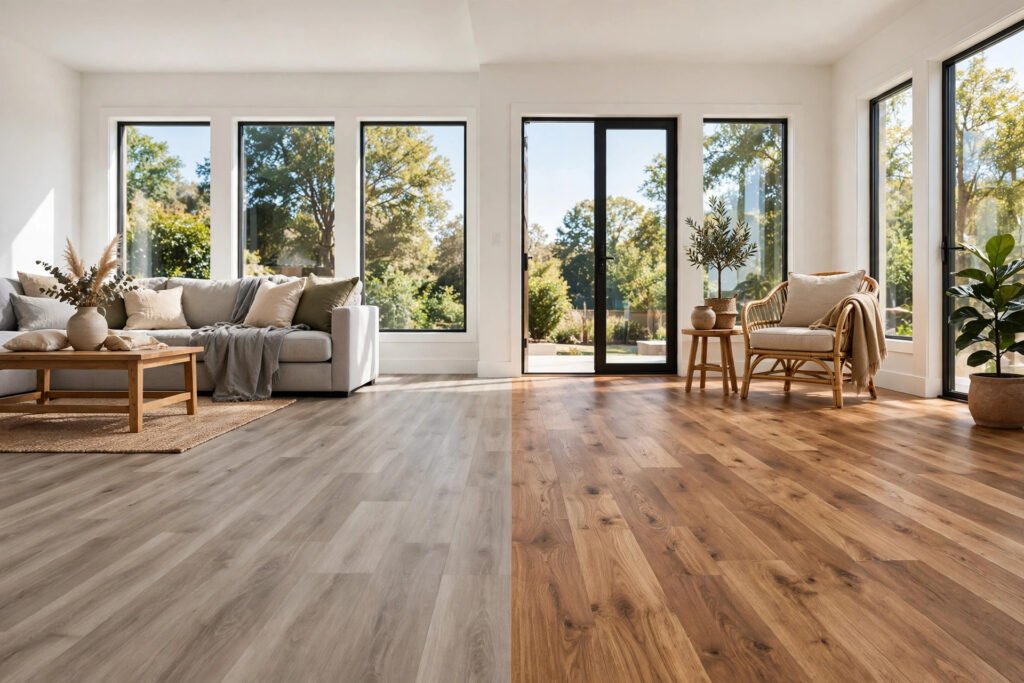
# Laminate vs Hardwood Flooring: Real Cost Comparison
I've lived on both. My second house had laminate in the living room — installed it myself in a weekend for under two grand. My current house has solid oak hardwood upstairs that I paid a crew to install. The laminate looked great for about eight years. The oak looks better every year. But the price difference was enormous, and for some rooms the laminate was absolutely the right call.
Most cost comparisons you'll find online are vague — "laminate is cheaper" with no numbers attached. Here are the actual numbers from my projects and current 2026 pricing, broken down so you can price your own room.
The Short Answer
For a typical 400 sq ft living area:
- Laminate (DIY): $1,200–$2,400 all-in
- Laminate (pro-installed): $2,400–$4,400
- Engineered hardwood (pro-installed): $4,800–$8,000
- Solid hardwood (pro-installed): $5,600–$10,000+
Laminate costs roughly one-third to one-half of hardwood installed. The gap narrows if you install hardwood yourself (possible but genuinely difficult) and widens with premium wood species and complex layouts.
Material Costs: Side by Side
This is the per-square-foot cost of the flooring itself, before installation:
| Flooring Type | Material Cost per Sq Ft | 400 Sq Ft Materials | Lifespan |
|---|---|---|---|
| Budget laminate | $1.00–$1.75 | $400–$700 | 10–15 years |
| Mid-range laminate | $2.00–$3.50 | $800–$1,400 | 15–25 years |
| Premium laminate | $3.50–$5.00 | $1,400–$2,000 | 20–30 years |
| Engineered hardwood | $4.00–$8.00 | $1,600–$3,200 | 20–40 years |
| Solid hardwood (oak) | $5.00–$10.00 | $2,000–$4,000 | 50–100 years |
| Solid hardwood (walnut, hickory) | $8.00–$15.00 | $3,200–$6,000 | 50–100 years |
The overlap surprises people: premium laminate costs about the same per square foot as budget engineered hardwood. That's where the decision gets interesting — and where most people should be comparing, not budget laminate versus premium walnut.
Installation Costs
Laminate is a floating click-lock floor. No nails, no glue (usually), no sanding. A careful beginner can install it — I did 450 sq ft in two days having never done it before. Pro installation runs $2–$4 per sq ft for labor.
Hardwood is nailed or stapled down (solid) or glued/floated (engineered). It requires a perfectly flat subfloor, moisture testing, and acclimation — the wood sits in your house for 3–7 days before installation so it adjusts to your humidity. Pro installation runs $4–$8 per sq ft for solid hardwood, $3–$6 for engineered.
| Installation Method | Laminate Labor per Sq Ft | Hardwood Labor per Sq Ft |
|---|---|---|
| DIY | $0 (your weekend) | $0 (not recommended for beginners) |
| Pro install | $2–$4 | $4–$8 (solid), $3–$6 (engineered) |
| Pro install, 400 sq ft total | $800–$1,600 | $1,600–$3,200 |
DIY hardwood installation is where confident beginners lose money. The nailer rental, the wasted boards from bad cuts, the squeaks from improper fastening — I've seen a DIY oak floor that cost more in fixes than pro installation would have. Laminate forgives; hardwood doesn't.
Full Project Cost: My 400 Sq Ft Living/Dining Area
Let me price the same project three ways — this is the room I actually did in laminate in house #2, repriced with what hardwood would have cost:
Option A: Mid-range laminate, DIY
- Flooring (400 sq ft + 10% waste = 440 sq ft × $2.75): $1,210
- Underlayment (400 sq ft × $0.50): $200
- Transitions, quarter-round, misc: $120
- Tool rental/purchase (tap block, pull bar, spacers): $60
- Total: $1,590
Option B: Mid-range laminate, pro-installed
- Flooring and underlayment: $1,410
- Labor (400 × $3): $1,200
- Total: $2,610
Option C: Solid oak hardwood, pro-installed
- Flooring (440 sq ft × $7.50): $3,300
- Labor (400 × $6): $2,400
- Total: $5,700
The hardwood cost 3.6× the DIY laminate. That's the real gap for a real room — not a vague "hardwood costs more."
The 15-Year True Cost (This Changes the Math)
Sticker price isn't the whole story. Here's what 15 years actually costs, including maintenance and likely replacement:
| Cost Over 15 Years | Mid-Range Laminate (DIY) | Solid Oak (Pro) |
|---|---|---|
| Initial install | $1,590 | $5,700 |
| Maintenance (15 yrs) | ~$100 (cleaning supplies) | ~$800 (recoating once ~$2/sq ft at year 10) |
| Replacement | $1,590 (replace at year 12–15) | $0 (refinish instead: ~$1,200 at year 15 if needed) |
| 15-year total | ~$3,280 | ~$7,700 |
Laminate is still cheaper over 15 years — but the gap shrinks from 3.6× to about 2.3×, because hardwood can be refinished instead of replaced. Over 30 years, with one laminate replacement cycle versus one hardwood refinish, hardwood can actually pull even or ahead. My oak floors upstairs are 40 years old (original to a previous renovation) and on their second refinish — try that with laminate.
Resale value is the other long-term factor. In my market, real hardwood consistently appraises $3–$5 more per square foot than laminate in comparable homes. On 400 sq ft, that's $1,200–$2,000 of the price gap returned at sale. Laminate returns essentially nothing — buyers see it as a wear item.
Beyond Price: How They Actually Compare
Cost got you here, but don't decide on price alone. Here's the honest breakdown from living on both:
| Factor | Laminate | Hardwood |
|---|---|---|
| Scratch resistance | Excellent — aluminum oxide coating shrugs off dog claws | Fair — scratches, but can be refinished |
| Water resistance | Poor (standard) to good (waterproof lines) — swells if water sits | Poor — warps and stains with standing water |
| Feel underfoot | Harder, clickier, can sound hollow | Solid, warm, quiet |
| Repairability | Replace individual planks (fiddly but doable) | Sand and refinish entire floor, or replace boards |
| DIY difficulty | Beginner-friendly weekend project | Advanced — hire a pro |
| Appearance | Good ones fool most people; cheap ones look plasticky | Depth and variation no print can match |
The water issue deserves emphasis: standard laminate and a dishwasher leak are a total loss — the planks swell and there's no fixing it. I lost a 100 sq ft section of laminate to a slow ice-maker leak that I didn't catch for a month. If your room has any water risk (kitchens, entries, near bathrooms), either buy waterproof-rated laminate/luxury vinyl or accept hardwood's risk with eyes open. Neither is waterproof; both punish standing water.
Decision Table: Which Should You Buy?
| Your Situation | My Recommendation | Why |
|---|---|---|
| Rental property or flip | Budget/mid laminate | Lowest cost, looks fresh, 10-year horizon is fine |
| Kids + dogs, busy family room | Mid-range laminate | Scratch resistance beats everything else |
| Forever home, living/dining/bedrooms | Solid or engineered hardwood | Refinishing, resale, and the feel justify it |
| Kitchen or mudroom | Waterproof laminate or LVP (not standard laminate or hardwood) | Water risk rules out both standard options |
| Tight budget, DIY skills | Laminate, DIY | $1,500 transforms a room; hardwood can't touch that |
| Upstairs bedrooms | Engineered hardwood | Quieter than laminate, less cost than solid |
My personal rule now: laminate for rentals, high-chaos family spaces, and budget-constrained projects; hardwood for the rooms I'll live with for decades. In my current house, that's laminate in the kids' playroom and oak everywhere else. No regrets on either.
Common Mistakes
Comparing budget laminate to premium hardwood. Compare at the same tier — premium laminate versus engineered hardwood is the honest comparison, and it's much closer than people expect.
Ignoring installation in the budget. A $2/sq ft laminate with $4/sq ft pro installation is a $6/sq ft floor. DIY changes the math enormously for laminate and barely at all for hardwood.
Installing standard laminate in a kitchen. Water finds a way. Use waterproof-rated products near sinks, dishwashers, and ice makers, or choose a different material.
Skipping acclimation for hardwood. Wood expands and contracts with humidity. Installing it the day it arrives guarantees gaps in winter and buckling in summer. 3–7 days of acclimation in the room, minimum.
Forgetting transitions and trim in the budget. Stair noses, T-moldings, reducers, and quarter-round add $100–$300 to a project. Hardwood transitions cost more than laminate ones.
Buying hardwood for a rental. Tenants won't maintain it, and you'll never recover the premium. Laminate is the rational rental choice every time.
FAQ
Is laminate cheaper than hardwood? Yes, substantially. Installed laminate runs $3–$8 per sq ft all-in (DIY to pro), while installed solid hardwood runs $9–$18 per sq ft. For a 400 sq ft room, that's roughly $1,600–$2,600 for laminate versus $5,700+ for oak. The gap narrows over decades because hardwood can be refinished instead of replaced.
How long does laminate flooring last compared to hardwood? Mid-range laminate lasts 15–25 years and then gets replaced. Solid hardwood lasts 50–100 years with periodic refinishing (every 10–15 years at $3–$5 per sq ft). Engineered hardwood falls in between at 20–40 years depending on veneer thickness.
Can I install laminate myself but not hardwood? That's exactly the right instinct. Laminate's click-lock floating system is one of the most beginner-friendly flooring projects — basic tools, no nails, no glue. Hardwood needs a flooring nailer, subfloor prep, and experience to avoid squeaks and gaps. DIY laminate saves $800–$1,600; DIY hardwood usually costs more in mistakes than pro installation.
Does hardwood increase home value more than laminate? Yes. Real hardwood typically adds $3–$5 per sq ft to appraised value over laminate in comparable homes, and it's a genuine selling feature buyers pay for. Laminate is viewed as a neutral-to-slight-positive — it looks clean and new, but nobody pays extra for it.
Which is better for dogs: laminate or hardwood? Laminate, by a clear margin. The aluminum oxide wear layer resists claw scratches far better than wood finish. Hardwood will show scratches from large dogs within months (though it can be refinished). If you go hardwood with dogs, choose a harder species like hickory and a matte finish that hides wear.
About the Author
Dave Collins is a hands-on DIY enthusiast who has spent the past 15 years renovating three of his own homes. He learned most of what he knows by making mistakes first, then asking pros what he did wrong. On this site he writes practical, numbers-first guides so you can skip the mistakes and get it right the first time.