
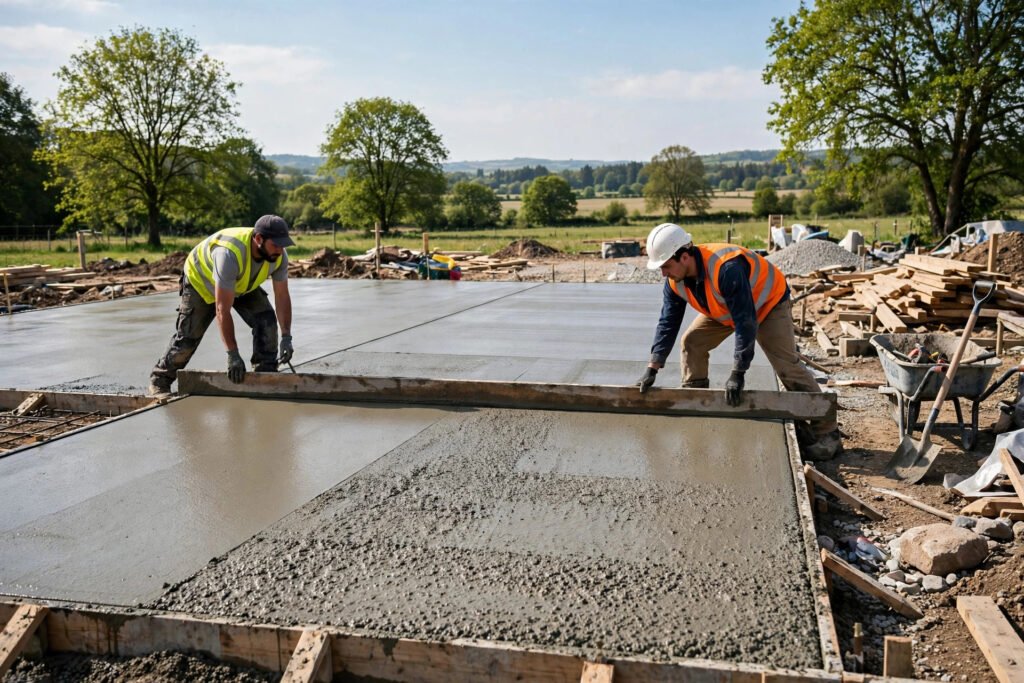
Nothing ruins a concrete pour day like running short with half a slab still empty — or like paying for two extra cubic yards you didn't need. I've done both. The first taught me to always add a waste factor; the second taught me to actually do the math instead of guessing "yeah, that looks like about two yards."
The good news: calculating concrete for a slab is one simple formula. This guide walks through it with real examples, shows you how to convert to bags if you're mixing by hand, and helps you decide between bags, a ready-mix truck, or a trailer.
The Formula (It's Just One)
Concrete is ordered and priced by the cubic yard. One cubic yard equals 27 cubic feet. The formula:
(Length in feet × Width in feet × Thickness in feet) ÷ 27 = cubic yards needed
The part that trips people up is thickness, because slabs are specified in inches and the formula needs feet. Divide inches by 12:
- 4 inches = 0.333 feet (standard for patios, sidewalks, shed floors)
- 5 inches = 0.417 feet (light driveways)
- 6 inches = 0.5 feet (driveways, garage floors)
Then add 5–10% extra for waste — spillage, uneven subgrade, and the fact that your forms are never exactly the dimensions you planned.
Worked Example 1: A 10×12 Foot Patio Slab
This is the classic backyard patio. Let's run the numbers for 4 inches thick:
- Convert thickness: 4 inches ÷ 12 = 0.333 feet
- Multiply: 10 × 12 × 0.333 = 40 cubic feet
- Convert to cubic yards: 40 ÷ 27 = 1.48 cubic yards
- Add 10% waste: 1.48 × 1.10 = 1.63 cubic yards
So you'd order 2 cubic yards from a ready-mix plant (they generally sell in whole or half yards, and most have a 1-yard minimum anyway). That gives you a comfortable margin without paying for a full extra yard you'll never use.
Worked Example 2: A 12×12 Foot Shed Slab in Bags
Say you're mixing this one by hand with 80-lb bags. An 80-lb bag of concrete mix yields about 0.6 cubic feet of finished concrete. A 60-lb bag yields about 0.45 cubic feet.
- Convert thickness: 4 inches ÷ 12 = 0.333 feet
- Multiply: 12 × 12 × 0.333 = 48 cubic feet
- Add 10% waste: 48 × 1.10 = 52.8 cubic feet
- Divide by bag yield: 52.8 ÷ 0.6 = 88 bags
Eighty-eight 80-lb bags is 7,040 pounds — over three and a half tons. This is the example I use to talk people out of hand-mixing big slabs. At some point the math is telling you to call a truck.
For reference, here are common slab sizes at 4 inches thick, waste included:
| Slab size | Cubic feet | Cubic yards (order) | 80-lb bags needed |
|---|---|---|---|
| 8×10 ft | 29.3 | 1.25 (order 1.5) | 49 |
| 10×10 ft | 36.7 | 1.5 (order 2) | 62 |
| 10×12 ft | 44.0 | 1.75 (order 2) | 74 |
| 12×12 ft | 52.8 | 2 (order 2.5) | 88 |
| 12×16 ft | 70.4 | 2.75 (order 3) | 118 |
| 16×20 ft | 117.3 | 4.5 (order 5) | 196 |
Bags vs. Ready-Mix vs. Trailer: How to Decide
How you buy the concrete matters as much as how much. Here's the decision framework I use:
| Method | Best quantity range | Approx. cost per cu yd | Notes |
|---|---|---|---|
| 80-lb bags, hand mixed | Under ~1 cu yd (27 cu ft) | $160–$240 | Brutal labor; fine for small pads |
| Bags in a rented mixer | 1–2 cu yd | $140–$200 | Mixer rental ~$50/day; much faster |
| Ready-mix truck delivery | 2+ cu yd | $110–$160 | Short-load fees under ~4 yards |
| Tow-behind trailer (U-cart) | 1–1.75 cu yd | $100–$140 | You haul it; must pour within ~1 hour |
The crossover point most people miss is the short-load fee. Ready-mix plants charge extra for loads under about 4 cubic yards — often $50–$100. So ordering 2 yards at $130/yard plus a $75 short-load fee is $335, versus about $200 in bags plus a mixer rental. For 2 yards I'd still take the truck — the labor savings are enormous — but for 1 yard, bags in a rented mixer usually win.
My personal rules of thumb:
- Under 1 cubic yard: bags, mixed in a wheelbarrow or rented mixer.
- 1–2 cubic yards: bags with a rented mixer, or a U-cart trailer if a plant is nearby.
- Over 2 cubic yards: ready-mix truck, no question.
Step-by-Step: Calculating and Ordering
- Measure the slab area. Length × width in feet. Measure twice — I once ordered based on a "12 foot" side that was actually 12 feet 6 inches.
- Confirm your thickness. 4 inches for patios and walkways, 5–6 for driveways. Mark it on your forms and check with a tape measure in several spots.
- Run the formula. (L × W × thickness in feet) ÷ 27, then add 5–10% waste. Use 10% if your subgrade is rough or your forms are homemade.
- Decide bags vs. truck using the ranges above.
- If ordering a truck: call the plant a day or two ahead. Tell them the yardage, the mix strength you want (3,000–3,500 psi is standard for residential slabs), and your address. Ask about the short-load fee and the delivery window.
- If buying bags: buy them all at once from the same pallet if possible, and store them dry. One rain-soaked bag is one ruined bag.
- Have help lined up. Concrete waits for no one. For a truck delivery, you want at least two helpers with wheelbarrows or a straight shot for the chute.
Case Study: My 10×14 Shed Slab
When I built my shed, I needed a 10×14 slab at 4 inches thick. The math: 10 × 14 × 0.333 = 46.7 cubic feet, ÷ 27 = 1.73 yards, × 1.10 waste = 1.9 yards. I priced both options:
- Bags: 86 bags at $4.75 each = $409, plus a $50 mixer rental = $459, plus an entire Saturday of backbreaking mixing.
- Ready-mix: 2 yards at $135/yard = $270, plus a $60 short-load fee = $330, poured in 20 minutes.
I took the truck. The pour was done before 9 a.m., I spent the rest of the day screeding and finishing instead of mixing, and I saved $129. The only thing I'd change: I wish I'd ordered 2.5 yards instead of 2, because my subgrade had a low spot that ate more concrete than I estimated. I finished with about half a wheelbarrow to spare, which was closer than I like.
Common Mistakes
- Forgetting to convert inches to feet. Multiplying by 4 (inches) instead of 0.333 (feet) gives you twelve times too much concrete. It sounds dumb until you've seen someone do it.
- Skipping the waste factor. Forms bow, subgrade dips, wheelbarrows spill. Five percent is the absolute minimum; ten is safer for DIY.
- Measuring the forms instead of the hole. Measure the actual excavation or the inside of the forms — whichever the concrete will fill.
- Ignoring the short-load fee in the budget. A "cheap" $120/yard quote becomes expensive when there's a $100 fee on a 1-yard order. Always ask.
- Ordering exact yardage with no margin. The plant's meter isn't perfect and neither is your excavation. Running half a yard short means a cold joint in your slab — a visible, weaker seam. Order the extra half yard.
- Not having a plan for leftover concrete. Have a form ready for a stepping stone, a small pad, or an extra sidewalk square. Leftover concrete in the truck costs you money either way; a spare form turns it into something useful.
FAQ
How many 80-lb bags of concrete do I need for a 10×10 slab at 4 inches thick?
A 10×10 slab at 4 inches is 33.3 cubic feet, or 36.7 with 10% waste. Divide by 0.6 cubic feet per 80-lb bag and you get 62 bags (round up). That's over two tons of material — consider a ready-mix truck instead.
How thick should a concrete slab be for a patio?
Four inches is the standard for patios, walkways, and shed floors. Go 5–6 inches for driveways or anything supporting vehicles, and always pour on 4 inches of compacted gravel base.
What does a cubic yard of concrete cost delivered?
Typically $110–$160 per cubic yard for standard residential mix, plus a short-load fee of $50–$100 if you order less than about 4 yards. Prices vary by region and by season — call two local plants and compare.
Can I pour a slab in sections on different days?
You can, but each pour creates a cold joint — a visible seam that's weaker than the surrounding concrete. For small slabs it's better to pour all at once. If you must split it, plan the joint at a control joint location and use a bonding agent.
How much concrete do I need for footings?
Use the same formula: length × width × depth in feet, divided by 27. A typical deck footing — a 12-inch diameter hole 36 inches deep — is about 2.8 cubic feet, or roughly 5 bags of 80-lb mix. For a whole deck's worth of footings, add them up and consider bags in a mixer.
About the Author
Dave Collins is a hands-on DIY enthusiast who has spent the past 15 years renovating three of his own homes. He learned most of what he knows by making mistakes first, then asking pros what he did wrong. On this site he writes practical, numbers-first guides so you can skip the mistakes and get it right the first time.