
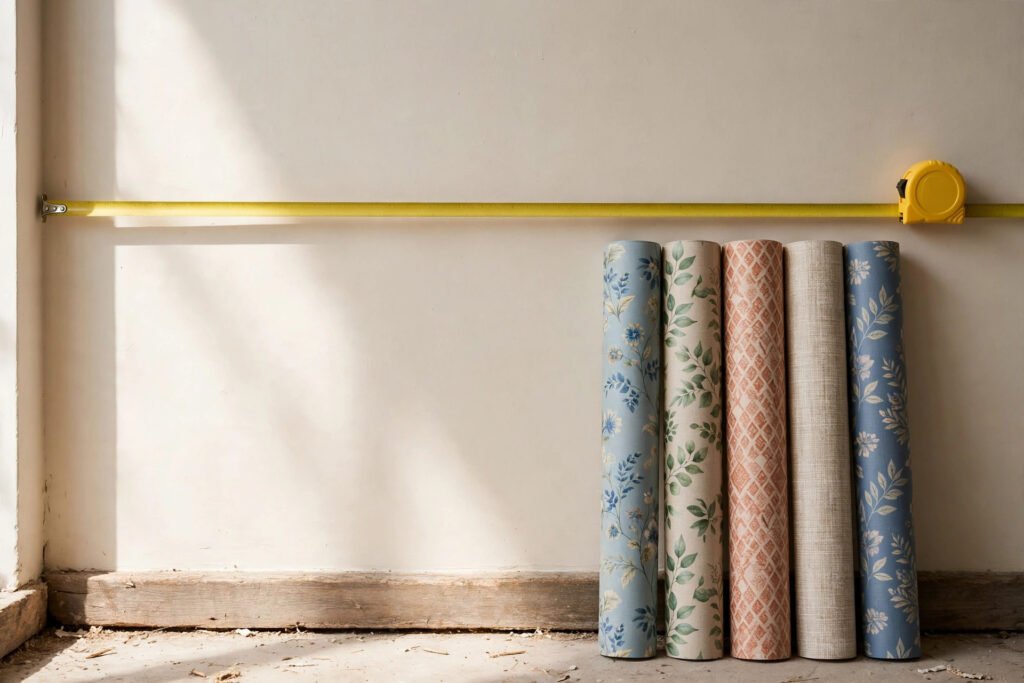
Ordering wallpaper is the one part of the project where a tape measure matters more than a smoothing brush. Order too little and you'll discover — mid-project, on a Saturday — that the next dye lot doesn't match. Order too much and you've spent $60 a roll on paper that sits in your garage forever. I've done both, and the math to avoid both takes about fifteen minutes.
This guide is only about measuring and ordering. (For the hanging itself, see my guide on hanging wallpaper without bubbles.) We'll measure the room, subtract the openings, account for pattern repeat, and convert it all into an exact roll count.
What You Need to Know Before Measuring
Three facts drive every wallpaper calculation:
- US single roll: typically 21 inches wide × 16.5 feet long, covering about 28 square feet. This is the standard American roll.
- US double roll: twice the length (33 feet), covering about 56 square feet. Most wallpaper sold in the US today is actually double rolls, even when the price is quoted "per roll." Check the label.
- Pattern repeat: the vertical distance before the pattern starts over — commonly 12, 18, or 21 inches. Every panel you cut must waste up to one full repeat to keep the pattern aligned, and this is where most under-ordering happens.
Also note the dye lot (or batch number) printed on every roll. Rolls from different dye lots can have slightly different shades. Buy all your rolls at once from the same lot, plus one spare — you cannot reliably match the color later.
Step 1: Measure the Walls
Measure each wall's width in feet and inches, and the ceiling height. Don't measure the whole room as one number — measure wall by wall, because you'll subtract doors and windows per wall.
Record it like this (my actual guest bedroom):
| Wall | Width | Openings |
|---|---|---|
| North | 12 ft 0 in | 1 window (3×5 ft) |
| South | 12 ft 0 in | 1 door (3×6.7 ft) |
| East | 14 ft 0 in | none |
| West | 14 ft 0 in | 1 window (3×5 ft) |
| Ceiling height | 8 ft 0 in | — |
Total wall perimeter: 12 + 12 + 14 + 14 = 52 linear feet. Total gross wall area: 52 × 8 = 416 square feet.
Step 2: Subtract Doors and Windows (With a Catch)
Calculate the area of each opening and subtract it — but only count full openings. Here's the catch the online calculators don't tell you: you still need paper above doors and below/above windows, so don't subtract the entire opening blindly. The standard method:
- Subtract the full area of each opening.
- The leftover strips (above the door, around the window) are covered by your waste allowance and pattern-repeat offcuts.
For my guest bedroom:
- Windows: 2 × (3 × 5) = 30 sq ft
- Door: 3 × 6.67 = 20 sq ft
- Total openings: 50 sq ft
- Net wall area: 416 − 50 = 366 sq ft
Step 3: Account for Pattern Repeat
This is the step that separates an accurate order from a short one. With a patterned paper, each panel must start at the same point in the pattern, so you cut each panel to a multiple of the repeat.
The formula per panel: panel length = ceiling height rounded up to the next multiple of the pattern repeat, plus 4 inches (2 inches top and bottom for trimming).
Example with my 8-foot (96-inch) ceiling:
| Pattern repeat | Panels per 16.5-ft single roll | Math |
|---|---|---|
| No pattern (or random match) | 2 | 96 + 4 = 100 in; 198 ÷ 100 = 1.98 → 2 panels |
| 12-inch repeat | 2 | round 100 up to 108; 198 ÷ 108 = 1.83 → 1 panel… see note |
| 18-inch repeat | 1 | round 100 up to 108; 198 ÷ 108 = 1.83 → 1 panel |
| 21-inch repeat | 1 | round 100 up to 126; 198 ÷ 126 = 1.57 → 1 panel |
Wait — look at the 12-inch repeat row. 198 ÷ 108 = 1.83, which means you get 1 full panel and 90 inches left over — not enough for a second 108-inch panel. So a 12-inch repeat on 8-foot ceilings yields only 1 usable panel per single roll, same as an 18-inch repeat. This is the brutal math of pattern matching, and it's why patterned paper costs so much more in practice than the per-roll price suggests.
Real-world check: my guest bedroom used a paper with an 18-inch repeat. One panel per single roll.
Step 4: Calculate How Many Panels and Rolls You Need
Now put it together for my guest bedroom:
- Panels needed: perimeter 52 ft = 624 inches, ÷ 21-inch panel width = 29.7 → 30 panels.
- Panels per roll: with an 18-inch repeat on 8-foot ceilings, 1 panel per single roll (2 per double roll).
- Single rolls needed: 30 × 1 = 30 single rolls = 15 double rolls.
- Add one spare double roll for mistakes and future repairs → 16 double rolls.
Compare that to the naive calculation: 366 sq ft ÷ 28 sq ft per single roll = 13 single rolls. The naive math says 13; the real answer is 30 single rolls (15 double). Pattern repeat more than doubled the order. If I had ordered 13 rolls, I would have run out less than halfway through the room.
Here's a quicker estimation method once you understand the mechanics:
| Ceiling height | No-pattern paper | Small repeat (≤12 in) | Large repeat (≥18 in) |
|---|---|---|---|
| 8 ft | ÷ 56 sq ft per double roll | ÷ 45 sq ft per double roll | ÷ 30 sq ft per double roll |
| 9 ft | ÷ 50 sq ft per double roll | ÷ 40 sq ft per double roll | ÷ 28 sq ft per double roll |
| 10 ft | ÷ 45 sq ft per double roll | ÷ 36 sq ft per double roll | ÷ 25 sq ft per double roll |
Take your net wall area, divide by the divisor for your situation, round up, and add one spare roll. For my room: 366 ÷ 30 = 12.2 → 13, plus spare = 14… hmm, that's one less than my exact count of 16. The table is a fast estimate; the panel-by-panel method is exact. When they disagree, trust the panel math — it accounts for your specific wall widths.
Step 5: Single Rolls vs. Double Rolls — What to Actually Buy
Most US wallpaper is sold as double rolls now, but pricing and labeling are inconsistent. Before you buy:
| Question | Why it matters |
|---|---|
| Is the price per single or double roll? | A "$45 roll" that's a single roll costs $90 per double-roll equivalent |
| What's the exact coverage in sq ft? | European papers often have different roll sizes (e.g., 20.5 in × 33 ft) |
| What's the pattern repeat and match type? | Straight match vs. half-drop changes waste |
| What's the dye lot? | All rolls must match; buy together |
Straight match vs. half-drop match: In a straight match, the pattern aligns at the same height on every panel. In a half-drop (or brick) match, every other panel is offset by half a repeat — which usually means more waste, because alternating panels need different cut points. If your paper is a half-drop match, add one more spare roll to your order.
Case Study: My Hallway (Where I Got It Wrong)
Before the guest bedroom, I papered a small hallway: 3 feet wide, 10 feet long, 8-foot ceilings, no pattern (a textured grasscloth-look paper). Perimeter: 26 feet. Net area after one door: about 188 sq ft.
Naive math: 188 ÷ 56 per double roll = 3.36 → 4 double rolls. I bought 4. No pattern meant 2 panels per single roll (4 per double), and I needed 15 panels — 4 double rolls gave me 16 panels. It worked with exactly one panel to spare.
Then I decided to do the guest bedroom with a patterned paper and used the same naive confidence. I initially ordered 8 double rolls for it. When the panel math showed I needed 15, I had to place a second order and pray the dye lots matched. They did — barely — but I spent a week stressed about it. Now I do the panel math first, every time, and I order the spare roll without guilt.
Common Mistakes
- Dividing wall area by roll coverage and stopping there. This ignores pattern repeat entirely and virtually guarantees a short order on patterned paper.
- Forgetting the 4 inches per panel. You need 2 inches top and bottom for trimming. On 30 panels, that's 10 feet of paper the naive calculation never counted.
- Not checking single vs. double roll. Ordering "15 rolls" when you need 15 double rolls but the site sells singles leaves you with half the paper.
- Mixing dye lots. Two orders placed weeks apart can differ visibly. Buy everything at once, including the spare.
- Measuring the room perimeter as one number. Measure wall by wall. Openings, bump-outs, and angled walls all hide in a single perimeter number.
- Skipping the spare roll. One damaged panel, one bad cut, one future repair — the spare roll is the cheapest insurance in the whole project. Store it sealed, upright, in a dry place.
FAQ
How many rolls of wallpaper do I need for a 12×12 bedroom?
For 8-foot ceilings with no doors or windows: 48 linear feet of wall needs about 28 panels at 21 inches wide. With no pattern, that's 7 double rolls plus a spare (8 total). With an 18-inch pattern repeat, it's 14 double rolls plus a spare (15 total). Subtract openings and run the panel math for your exact room.
What is a double roll of wallpaper?
A double roll is twice the length of a single roll — typically 33 feet instead of 16.5 feet — covering about 56 square feet. Most wallpaper in the US is sold as double rolls, but always check the label because pricing is sometimes quoted per single roll.
Do I need to subtract windows and doors when measuring for wallpaper?
Subtract the full area of each opening from your wall square footage, but remember you still need paper for the strips above doors and around windows — your waste allowance and pattern-repeat offcuts cover those. Don't subtract partial credit beyond the opening itself.
What does pattern repeat mean?
The pattern repeat is the vertical distance before the design starts over — for example, 18 inches. Every panel must be cut to a multiple of the repeat so the pattern aligns across panels, which wastes up to one full repeat per panel. Larger repeats mean more waste and more rolls.
Can I mix dye lots if I run short?
You shouldn't. Rolls from different dye lots can have visibly different shades, and the difference usually shows at the seams. If you must mix lots, use one lot per wall so any variation reads as a deliberate break rather than a patchy mistake — but ordering enough from one lot in the first place is far better.
About the Author
Dave Collins is a hands-on DIY enthusiast who has spent the past 15 years renovating three of his own homes. He learned most of what he knows by making mistakes first, then asking pros what he did wrong. On this site he writes practical, numbers-first guides so you can skip the mistakes and get it right the first time.